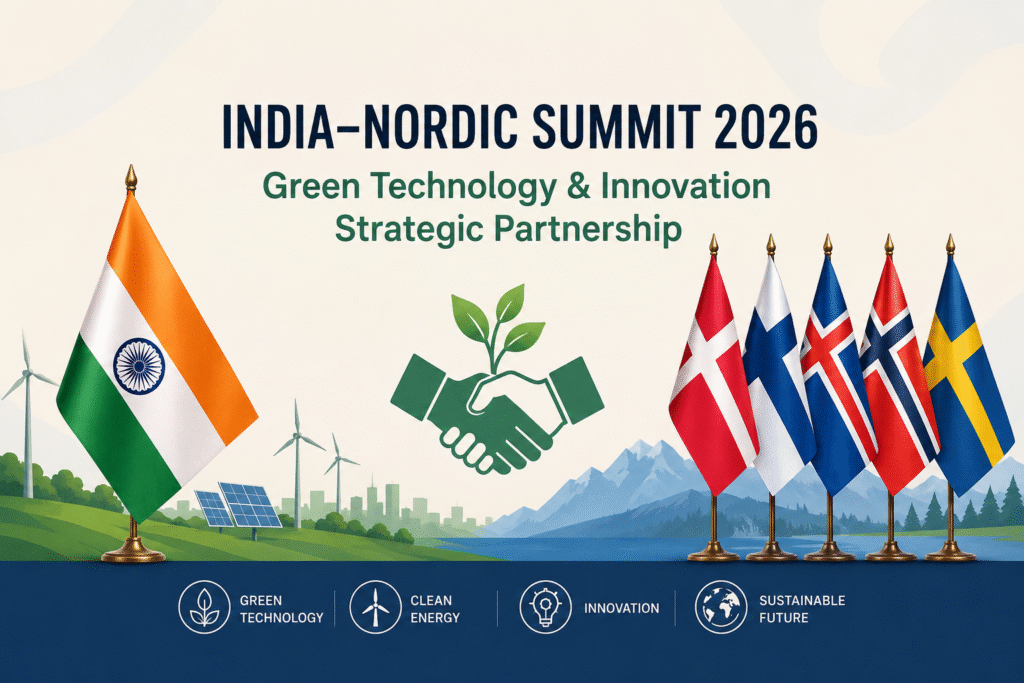
Prime Minister Narendra Modi and the Prime Ministers of Denmark, Finland, Iceland, Norway, and Sweden met in Oslo for the Third India-Nordic Summit. During the summit, they upgraded their relationship to a formal Green Technology and Innovation Strategic Partnership. This marks an important step in a partnership that started nearly ten years ago and has become one of India’s most forward-looking international relationships.
The Growing India-Nordic Partnership
The India-Nordic partnership began with the First India-Nordic Summit in 2018. That summit created a structured platform for cooperation in innovation, clean energy, and sustainable development. Since then, trade between India and the Nordic countries has increased four times, while investments have grown by nearly 200%. Leaders from both sides highlighted these achievements as proof of the partnership’s strong progress.
The Third Summit in Oslo took this relationship to the next level. In addition to strengthening existing ties, both sides agreed to expand cooperation into new areas, including renewable energy, green hydrogen, digital innovation, sustainable manufacturing, climate action, the blue economy, defence, STEM research, and Arctic cooperation. The leaders also discussed global issues, called for reforms in international institutions, and reaffirmed their strong commitment to combating terrorism.
Major Announcements from the India-Nordic Summit
1. Green Technology and Innovation Strategic Partnership
The most important outcome of the summit was the decision to upgrade India-Nordic relations into a Green Technology and Innovation Strategic Partnership. This new framework will help both sides work more closely on sustainable technologies, digital infrastructure, circular economy practices, the blue economy, climate action, water management, and energy security.
The partnership aims to create green jobs, improve governance through digital solutions, and support efforts to tackle climate change. It will also increase research cooperation and academic exchanges, giving Indian students, researchers, and teachers more opportunities to study and work internationally. At the same time, Nordic institutions will benefit from India’s large talent pool and research capabilities.
2. India-EFTA Trade and Economic Partnership Agreement (TEPA)
The leaders welcomed the recently completed India–European Free Trade Association (EFTA) Trade and Economic Partnership Agreement. They described it as the beginning of a “new golden era” in India-Nordic economic relations.
The agreement is expected to improve market access, reduce trade barriers, strengthen supply chains, and encourage more investments. EFTA countries have committed to investing USD 100 billion in India, which could create many jobs and support industrial growth in both regions.
3. Climate Action Initiatives
Climate cooperation was one of the main topics at the summit. The India-Nordic climate initiative aims to bring Nordic innovation to India and turn climate solutions into large-scale projects.
The initiative also supports sustainable lifestyles through India’s Mission LiFE and encourages cooperation in renewable energy and low-emission technologies. These efforts are expected to create green jobs, attract investment, and strengthen long-term economic growth.
4. Arctic Cooperation
The summit expanded India-Nordic cooperation in the Arctic region, which is becoming increasingly important for India. Climate change in the Arctic, especially the rapid melting of ice, affects India’s monsoon, agriculture, water security, and island territories.
Under India’s Arctic Policy, which focuses on research, environmental protection, and sustainable development, cooperation with Nordic countries is very important. Joint research projects will help scientists better understand climate systems and their impact on both regions.
5. STEM Research Collaboration
India and the Nordic countries agreed to start joint research projects in several STEM fields. They will also encourage cooperation between start-ups and innovation centres.
A major focus area will be next-generation communication technologies such as 6G. This research is expected to strengthen India’s digital infrastructure and support the growth of its digital economy.
6. Blue Economy
The blue economy, which focuses on the sustainable use of ocean and marine resources, was identified as a key area for cooperation.
India and the Nordic countries will work together through Maritime Security Dialogues and the Indo-Pacific Oceans Initiative (IPOI), supporting India’s vision of “MAHASAGAR.” This cooperation is expected to promote sustainable ship recycling, improve maritime connectivity, create jobs in coastal areas, and contribute to a secure Indo-Pacific region.
7. Mobility of Talent
Both sides agreed to make it easier for students, researchers, academics, and professionals to move between India and Nordic countries.
Greater movement of skilled people is expected to encourage innovation, entrepreneurship, and research while also strengthening people-to-people connections.
8. Defence Industrial Collaboration
The summit also discussed defence cooperation. India has opened its Defence Industrial Sector to 100% foreign direct investment (FDI) from Nordic companies.
This is expected to encourage technology transfers, increase domestic defence production, boost exports, create skilled jobs, and strengthen India’s defence capabilities.
Also Read: Thoothukudi Shipyard: India Signs Historic MoU with South Korea for 2.5 Million GT Facility
A Look at India’s Ties with Nordic Nations
Denmark, India’s largest Nordic trading partner in goods, recorded bilateral goods trade of USD 2.05 billion in 2025, while services trade reached USD 4.25 billion. Around 200 Danish companies operate in India in sectors such as shipping, renewable energy, and agriculture. About 40 Indian companies are active in Denmark. The Indian community of around 21,000 people has contributed significantly to cultural ties between the two countries.
Finland recorded a bilateral goods trade of USD 1.017 billion in 2024-25. Finnish investments in India have reached USD 4 billion. Around 33,000 Indians live in Finland, mainly working in the IT sector, while about 2,400 Indian students study at Finnish universities.
Iceland has the smallest trade relationship with India among the Nordic countries, with trade reaching USD 77.06 million in 2024-25. The summit highlighted opportunities for greater cooperation in geothermal energy, fisheries, and Arctic research.
Norway hosted the summit. Trade between India and Norway stands at USD 1.05 billion. Norway’s Government Pension Fund Global has invested nearly USD 28 billion in Indian capital markets. Future cooperation will focus strongly on the blue economy and Arctic issues.
Sweden has the highest overall trade volume among Nordic countries, with bilateral trade reaching USD 6.96 billion in 2024. Around 280 Swedish companies operate in India, while Swedish FDI in India totals USD 2.596 billion. Cultural relations are also strong, supported by events such as the Namaste Stockholm festival and long-standing academic studies of India.
Why the India-Nordic Partnership Is Important
The India-Nordic partnership is becoming an example of modern international cooperation focused on technology, sustainability, and innovation.
Nordic countries offer advanced expertise in green technology, clean energy, digital governance, and maritime sustainability. India contributes its large market, skilled workforce, manufacturing strength, and growing economy. Together, these strengths create significant opportunities for both sides.
India’s Arctic Policy adds another important dimension to the partnership. Nordic countries are valuable partners in helping India understand the effects of Arctic climate change, which directly influences weather patterns, agriculture, and water resources across India.
The India-EFTA TEPA also provides a strong economic foundation for future cooperation. With planned investments of USD 100 billion and a shared focus on resilient supply chains, economic ties between the two sides are expected to grow significantly.
A Stronger Future for India-Nordic Relations
The Third India-Nordic Summit in Oslo achieved much more than a diplomatic agreement. It created a clear roadmap for stronger cooperation in green energy, digital innovation, defence, research, climate action, and ocean governance.
As India and the Nordic countries face global challenges such as climate change, technological transformation, and economic uncertainty, this partnership provides a strong framework for working together. Built on shared values and complementary strengths, it has the potential to become one of the most important international partnerships of the coming decades.