RBI Marginal Standing Facility (MSF) Rate
RBI MSF Rate: Key Updates
MSF Rate Highlights – June MPC Meeting (Jun 3–5, 2026)
- The Monetary Policy Committee (MPC), at its 61st meeting held from June 3 to 5, 2026, kept the Marginal Standing Facility (MSF) rate unchanged at 5.50%, alongside its decision to maintain the policy repo rate at 5.25%.
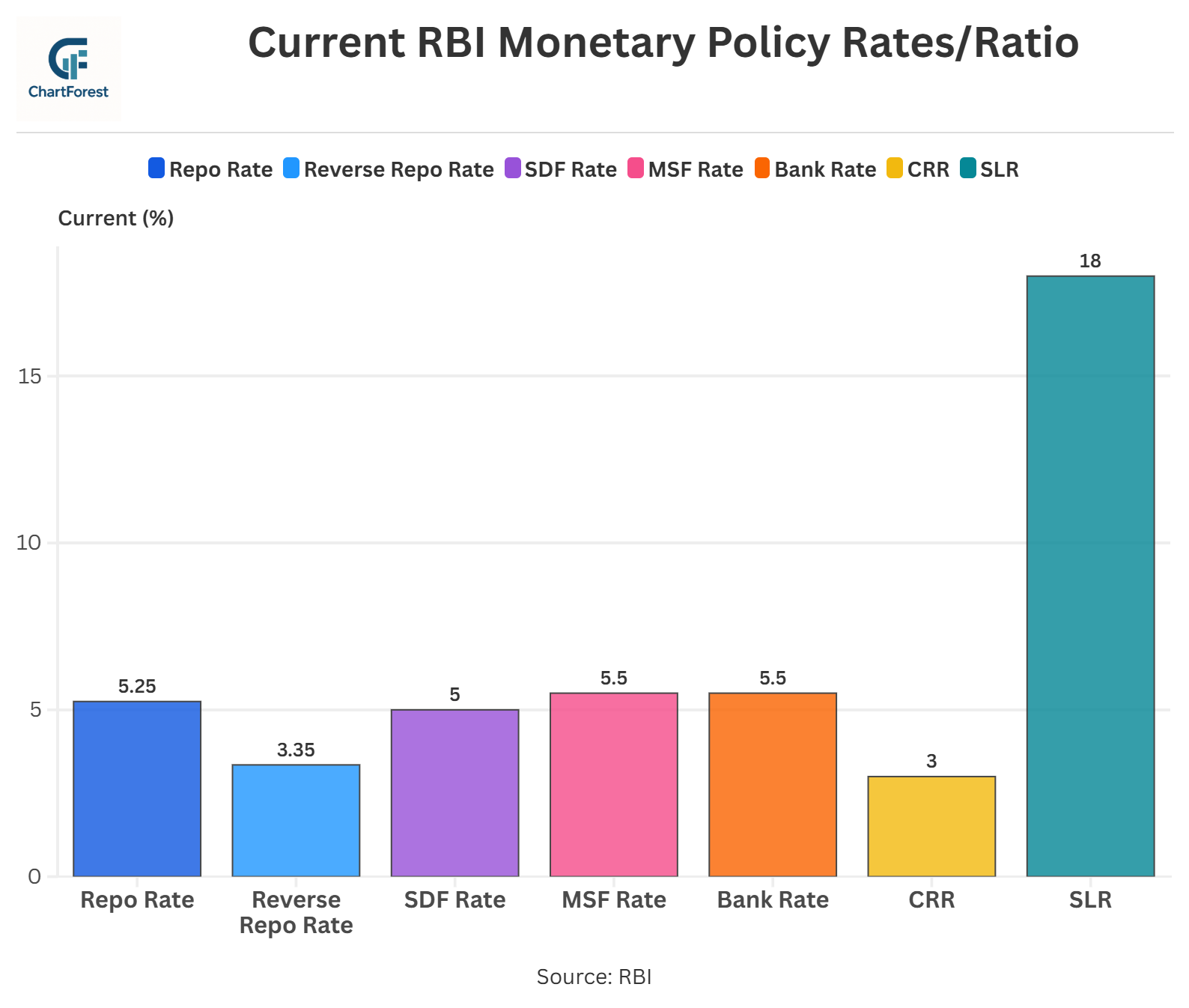
- The decision preserves the existing interest rate corridor, with the Standing Deposit Facility (SDF) rate at 5.00%, the repo rate at 5.25%, and the MSF rate at 5.50%.
- The MSF continues to serve as the upper bound of the Liquidity Adjustment Facility (LAF) corridor, allowing scheduled commercial banks to access overnight funds from the RBI during periods of liquidity stress.
- By keeping the MSF rate unchanged, the RBI aims to maintain orderly liquidity conditions and support the effective transmission of monetary policy across financial markets.
- The meeting was chaired by RBI Governor Shri Sanjay Malhotra, with members Dr Nagesh Kumar, Shri Saugata Bhattacharya, Prof. Ram Singh, Dr Poonam Gupta, and Shri Indranil Bhattacharyya in attendance.
- The MPC retained its neutral stance and highlighted growing risks from elevated energy prices, global supply-chain disruptions, financial market volatility, and uncertainty arising from the prolonged West Asia conflict.
- The RBI emphasised the importance of maintaining a stable SDF-Repo-MSF corridor structure to ensure liquidity discipline, money market stability, and flexibility in responding to future economic developments.
Reasons for Maintaining the MSF Rate
Alignment with the Repo Rate Decision: The RBI kept the MSF rate unchanged at 5.50% after deciding to maintain the policy repo rate at 5.25%. This ensures consistency within the monetary policy framework and preserves the existing interest rate corridor.
Rising Inflation Risks: The MPC noted that inflation risks have increased due to higher crude oil prices, firming commodity prices, and global supply-chain disruptions. Keeping the MSF rate unchanged allows the RBI to assess how these factors affect inflation before making further policy adjustments.
Increased Global Uncertainty: The prolonged West Asia conflict has created uncertainty in global energy markets and trade flows. With risks to both inflation and growth rising, the RBI chose to maintain the current policy settings until there is greater clarity on global developments.
Supporting Economic Growth: While domestic demand remains resilient, higher energy costs and external headwinds could weigh on economic activity. Maintaining the MSF rate helps avoid unnecessary tightening of financial conditions and supports the growth outlook.
Maintaining Liquidity Stability: The MSF acts as an emergency borrowing window for banks facing short-term liquidity shortages. Keeping the rate unchanged ensures that banks continue to have access to overnight liquidity at predictable costs when required.
Preserving the LAF Corridor Structure: The decision maintains the existing Liquidity Adjustment Facility (LAF) corridor, with the SDF rate at 5.00%, the repo rate at 5.25%, and the MSF rate at 5.50%. This helps guide short-term interest rates and supports effective monetary policy transmission.
Data-Dependent Policy Approach: The MPC emphasized that future policy decisions will depend on incoming data related to inflation, growth, commodity prices, and financial market conditions. Maintaining the MSF rate provides flexibility while the RBI monitors evolving economic risks.
Retaining a Neutral Monetary Policy Stance: By keeping the MSF rate unchanged, the RBI continues to maintain a neutral stance. This gives the central bank the flexibility to respond appropriately if inflationary pressures increase or if economic growth weakens in the months ahead.
Expected Effects of the Maintained MSF Rate
- Continued Access to Emergency Liquidity: By keeping the MSF rate unchanged at 5.50%, the RBI ensures that banks continue to have access to overnight funds during periods of temporary liquidity shortages. This helps maintain confidence in the banking system and supports smooth financial operations.
- Stable Money Market Conditions: The unchanged MSF rate helps anchor short-term money market interest rates and reduces the risk of excessive volatility in funding markets. Stable money markets are essential for the effective functioning of the financial system.
- Predictable Funding Costs for Banks: Banks can continue to access emergency liquidity from the RBI at the same cost as before. This predictability helps financial institutions manage their liquidity requirements more effectively and plan their funding strategies with greater certainty.
- Support for Financial Stability: Maintaining the MSF rate contributes to overall financial stability by ensuring that banks have a reliable liquidity backstop. This becomes particularly important during periods of global uncertainty and market volatility.
- Effective Monetary Policy Transmission: The unchanged MSF rate preserves the existing Liquidity Adjustment Facility (LAF) corridor, with the SDF rate at 5.00%, the repo rate at 5.25%, and the MSF rate at 5.50%. A stable corridor helps monetary policy signals flow smoothly through the banking system and financial markets.
- No Additional Tightening of Liquidity Conditions: Keeping the MSF rate unchanged prevents a further increase in short-term borrowing costs for banks. This helps avoid unnecessary tightening of liquidity conditions at a time when economic growth is facing external challenges.
- Alignment with the Neutral Policy Stance: The decision is consistent with the RBI’s neutral monetary policy stance. It allows the central bank to balance inflation risks with growth concerns while maintaining flexibility for future policy actions.
- Flexibility to Respond to Future Risks: By maintaining the current MSF rate, the RBI retains the ability to adjust policy settings if inflation rises more than expected or if economic growth weakens. This flexible approach enables policymakers to respond to changing economic conditions as they evolve.
Also Check: Standing Deposit Facility (SDF) Rate
RBI MSF Rate: Historical Chart
MSF Rate Chart (RBI) - Historical & Current Trends
RBI Monetary Policy Rates & Ratios
About RBI Marginal Standing Facility (MSF) Rate
Overview – MSF is a facility that commercial banks use. Banks (govt and private) can borrow funds overnight against their Statutory Liquidity Ratio (SLR) securities when interbank liquidity is scarce. It was introduced in 2011-12 to help financial institutions manage short-term liquidity problems.
Banks use it as an emergency funding option. The interest rate on MSF (MSF Rate) is higher than the repo rate to discourage banks from using it frequently.
The MSF aims to maintain stability in the banking system, manage short-term liquidity fluctuations, and avoid financial crisis. Borrowing under MSF allows banks to use their SLR securities, which is not permitted when borrowing under the Repo Rate.
Features Marginal Standing Facility (MSF) Rate –
- It has a higher Interest Rate so the MSF rate is kept higher than the repo rate to prevent overuse.
- It’s emergency borrowing so banks use MSF only when they cannot borrow from other sources.
- To borrow money from the RBI banks must keep collateral with the RBI.
- It’s known as an overnight Loan and banks must pay the money borrowed under MSF the next working day.
Impact of Marginal Standing Facility (MSF) Rate –
- Increase in MSF Rate: Borrowing becomes expensive for banks and banks may increase loan interest rates, making loans costlier for the public.
- Decrease in MSF Rate: Banks can borrow money at a lower cost and loans become cheaper for individuals and businesses. It also helps boost economic activity.
FAQs
The Marginal Standing Facility (MSF) is like a safety cushion set up by the Reserve Bank of India (RBI) to support banks when they face sudden cash crunches. Through this, scheduled commercial banks can borrow funds overnight by pledging government securities.
The repo rate is basically the interest rate at which banks can borrow money from the RBI using government securities under regular circumstances. On the other hand, the Marginal Standing Facility (MSF) rate is a bit higher and comes into play during emergencies when banks are dealing with severe cash crunches.
The Marginal Standing Facility (MSF) serves as a cap for short-term interest rates in the money market, acting like a gentle nudge from the RBI to encourage banks to borrow only when necessary and to handle liquidity more thoughtfully. By setting this higher-than-usual rate, the RBI signals how it plans to manage liquidity while also shaping interest rate trends across the economy. It’s a way the central bank keeps things steady, ensuring the financial system stays balanced and resilient.
Related Indicators
Other Indicators
Inflation and Price Indicators
GDP & Economic Growth Indicators
Trade & External Sector Indicators
Business & Industrial Indicators
Consumer & Labour Market Indicators
Important
If you notice any discrepancies in the data or find any inaccuracies, please let us know. We will review and correct them as soon as possible.