RBI Standing Deposit Facility (SDF) Rate
RBI SDF Rate: Key Updates
SDF Rate Highlights – June MPC Meeting (Jun 3–5, 2026)
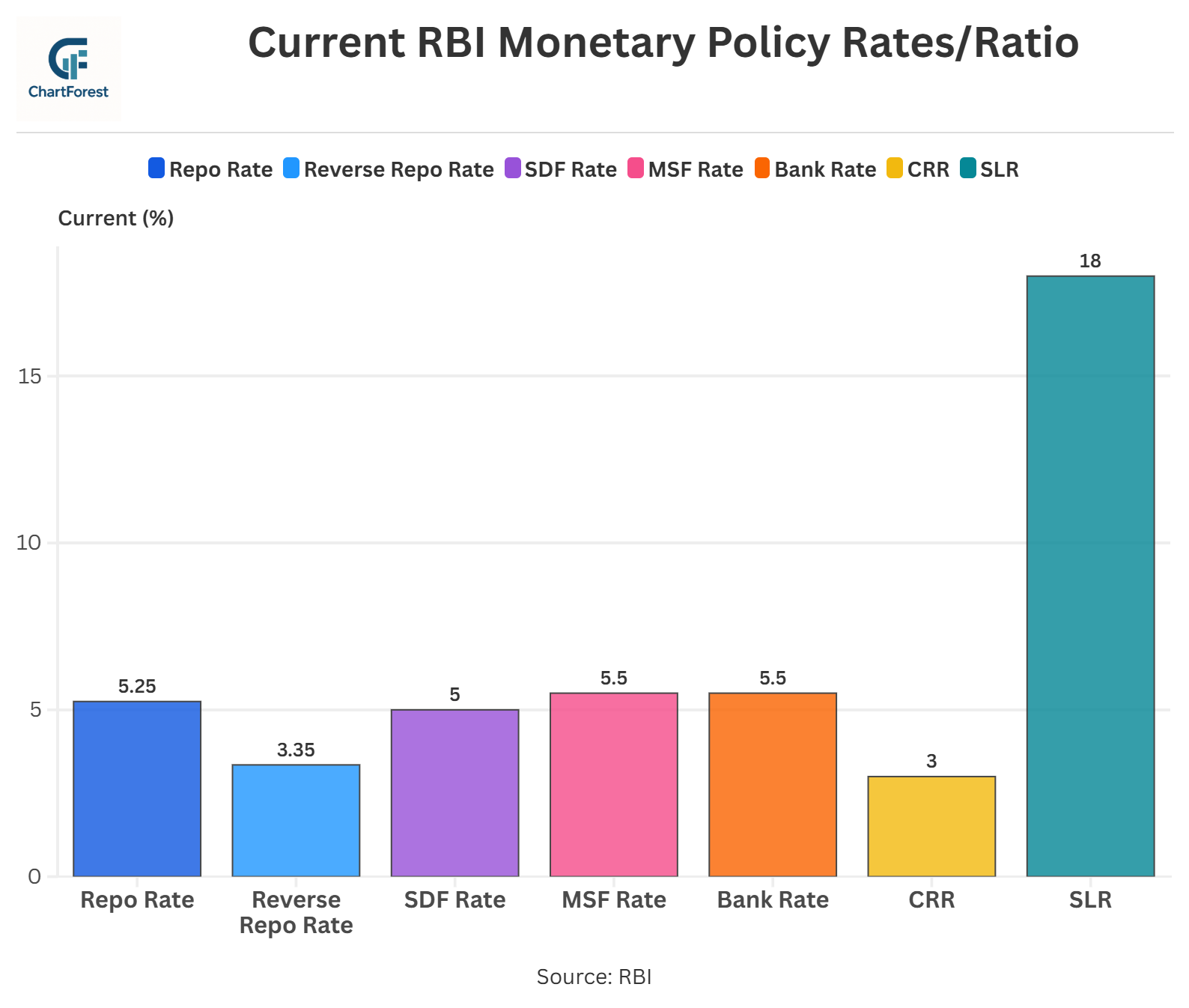
- The Monetary Policy Committee (MPC), at its 61st meeting held from June 3 to 5, 2026, kept the Standing Deposit Facility (SDF) rate unchanged at 5.00%, following its decision to maintain the policy repo rate at 5.25%.
- Consequently, the Marginal Standing Facility (MSF) rate and the Bank Rate were also retained at 5.50%, preserving the existing liquidity management framework.
- The decision maintains the 25-basis-point Liquidity Adjustment Facility (LAF) corridor, with the SDF rate serving as the lower bound and the MSF rate acting as the upper bound.
- The SDF continues to function as the floor of the LAF corridor, helping the RBI absorb surplus liquidity from the banking system and guide short-term money market interest rates.
- The meeting was chaired by RBI Governor Shri Sanjay Malhotra, with members Dr Nagesh Kumar, Shri Saugata Bhattacharya, Prof. Ram Singh, Dr Poonam Gupta, and Shri Indranil Bhattacharyya in attendance.
- The MPC retained its neutral stance and emphasised a data-dependent approach amid rising inflation risks, global supply chain disruptions, elevated energy prices, and uncertainty stemming from the prolonged conflict in West Asia.
- The committee highlighted the need to closely monitor inflation dynamics and growth conditions before considering any future changes to monetary policy settings.
Reasons for Maintaining the SDF Rate
Alignment with the Repo Rate Decision: The RBI kept the SDF rate unchanged at 5.00% after deciding to maintain the policy repo rate at 5.25%. Keeping both rates unchanged ensures consistency in the monetary policy framework and liquidity management operations.
Inflation Risks Have Increased: The MPC noted that inflation risks have risen due to higher crude oil prices, firming commodity prices, and ongoing global supply-chain disruptions. Maintaining the current SDF rate allows the RBI to monitor how these risks affect inflation before making policy adjustments.
Global Uncertainty Remains Elevated: The prolonged West Asia conflict, rising energy prices, and volatility in global financial markets have increased uncertainty for policymakers. The RBI preferred to wait for greater clarity on these developments before changing liquidity conditions.
Growth Outlook Has Moderated: The RBI lowered its FY 2026–27 GDP growth forecast to 6.6% from 6.9% projected in April. Maintaining the SDF rate helps avoid tightening financial conditions further while economic growth faces external headwinds.
Effective Liquidity Management: The SDF serves as the floor of the Liquidity Adjustment Facility (LAF) corridor and helps the RBI absorb surplus liquidity from the banking system. Keeping the rate unchanged ensures the smooth functioning of the liquidity management framework.
Retaining a Neutral Policy Stance: By keeping the SDF rate unchanged, the RBI continues to maintain a neutral monetary policy stance. This allows the central bank to respond appropriately to either rising inflationary pressures or weakening growth conditions in the future.
Expected Effects of the Maintained SDF Rate
- Stable Short-Term Interest Rates: By keeping the SDF rate unchanged at 5.00%, the RBI helps maintain stability in overnight and short-term money market rates. This reduces uncertainty in the financial system and supports smooth market functioning.
- Continued Liquidity Absorption: The SDF remains an important tool for absorbing surplus liquidity from the banking system without requiring collateral. Keeping the rate unchanged allows the RBI to continue managing liquidity efficiently while maintaining monetary policy stability.
- Predictable Banking System Liquidity: A stable SDF rate provides banks with a predictable return on surplus funds parked with the RBI. This helps financial institutions manage their liquidity positions more effectively.
- Support for Financial Market Stability: The decision signals policy continuity during a period of elevated global uncertainty. Stable liquidity conditions can help reduce volatility in money markets, bond markets, and other financial segments.
- Alignment with the Neutral Policy Stance: Maintaining the SDF rate is consistent with the RBI’s decision to retain a neutral monetary policy stance. This gives the central bank flexibility to respond to future changes in inflation and growth conditions.
- No Immediate Tightening of Financial Conditions: By keeping the SDF rate unchanged, the RBI avoids further tightening liquidity conditions at a time when economic growth is facing headwinds from global uncertainty, supply-chain disruptions, and higher energy prices.
- Better Transmission of Monetary Policy: A stable SDF rate helps maintain the existing Liquidity Adjustment Facility (LAF) corridor structure. This supports the effective transmission of monetary policy signals across the banking system and financial markets.
- Flexibility for Future Policy Actions: The unchanged SDF rate preserves the RBI’s ability to adjust liquidity conditions if inflation risks intensify or economic growth weakens. The central bank can respond quickly as new economic data becomes available.
Also Check: Marginal Standing Facility (MSF) Rate
RBI Standing Deposit Facility (SDF) Rate: Historical Chart
SDF Rate Chart (RBI) - Historical & Current Trends
RBI Monetary Policy Rates & Ratios
About RBI Standing Deposit Facility (SDF) Rate
Overview – SDF was Introduced by the Reserve Bank of India (RBI) on April 8, 2022. It is a monetary policy tool that allows commercial banks (both govt and private) to deposit excess/extra funds with the RBI without collateral. The main purpose of the SDF is to absorb surplus liquidity from the banking system, as it helps the RBI regulate inflation and improve monetary policy effectiveness.
Importance of RBI Standing Deposit Facility (SDF) policy
- Manage Liquidity: Enables commercial banks a secure and profitable way to temporarily deposit surplus funds with the RBI.
- Collateral-Free Deposits: Unlike other liquidity management tools like Reverse Repo, SDF does not require collateral. Therefore, it gives RBI more flexibility in liquidity absorption.
- Control Inflation: By absorbing excess liquidity from the market, SDF helps in preventing inflationary pressures.
- Helps alongside other tools: It works alongside other tools like the repo rate, reverse repo rate, CRR, MSF, and open market operations to improve the RBI’s control over liquidity.
- Stability: It also helps RBI to maintain price stability and support economic growth.
- Reduces volatility: It also helps reduce volatility in the money market and enhances overall stability.
FAQs
The Standing Deposit Facility (SDF) is a handy tool introduced by the Reserve Bank of India (RBI) to manage surplus funds in the banking system. Basically, it gives banks a simple way to park their extra money with the RBI and earn interest, all without needing to provide any security or collateral.
Both the Standing Deposit Facility (SDF) and the reverse repo rate help the RBI manage excess cash from banks, but there’s a key distinction between the two. The reverse repo rate requires banks to provide government securities as collateral, while SDF is much simpler—banks can park their money safely with the RBI without needing to deal with paperwork or pledging assets.
SDF is a tool the RBI uses to make sure its interest rate decisions, like changes to the repo rate, have the right impact on the economy. You see, when there’s too much money floating around, loan rates might stay low even if RBI hikes the repo rate. With the SDF, RBI can soak up that extra cash, helping market rates align better with its policy goals.
For investors, the SDF can give clues about the RBI’s plans. If the RBI uses SDF more often, it could mean tighter money policy, possibly leading to higher loan rates and slower growth—this may affect stock prices. Also, absorbing liquidity through SDF can reduce market funds, which may lead to lower trading activity.
Investors should follow RBI updates on SDF usage and any changes in its rate. Seeing how frequently the RBI uses SDF and the amounts involved can clue you in on whether they’re tightening or easing monetary policy. Pair that with economic news and global trends, and you’ll have some solid insights to make smarter decisions.
Related Indicators
Other Indicators
Inflation and Price Indicators
GDP & Economic Growth Indicators
Trade & External Sector Indicators
Business & Industrial Indicators
Consumer & Labour Market Indicators
Important
If you notice any discrepancies in the data or find any inaccuracies, please let us know. We will review and correct them as soon as possible.