India’s Goods and Services Tax (GST) collections reached ₹1,94,184 crore in May 2026, registering a 3.2% year-on-year increase from ₹1,88,172 crore collected in May 2025.
While the headline growth appears modest, the underlying picture is considerably stronger. The Ministry of Finance noted that May 2025 collections included a one-time payment of around ₹10,000 crore from a telecom operator related to spectrum allocation. After adjusting for this exceptional item, GST collections grew by approximately 9%, indicating healthier tax revenue growth than the headline number suggests.
Key Highlights
| Indicator | May 2026 | Growth |
| Gross GST Revenue | ₹1,94,184 Cr | +3.2% |
| Net GST Revenue | ₹1,66,904 Cr | +3.3% |
| GST from Imports | ₹59,654 Cr | +19.1% |
| Domestic GST Revenue | ₹1,34,530 Cr | -2.6% |
Import-related tax collections remained the main driver of growth, while domestic collections experienced some softness during the month.
Check Out Detailed Analysis: Goods and Services Tax (GST)
Import Collections Continue to Drive Revenue Growth
One of the most notable features of the May GST data was the strong performance of import-related revenues.
GST collected from imports increased by 19.1% year-on-year, reaching ₹59,654 crore. Net customs GST collections also recorded robust growth, suggesting strong import activity across the economy.
This trend continued in the first two months of the financial year. During April-May 2026, import-related GST collections rose 22.3%, significantly outpacing domestic revenue growth.
Higher imports of capital goods, intermediate goods and industrial inputs may indicate continued investment activity and manufacturing demand. However, policymakers will also watch whether import growth remains significantly stronger than domestic consumption growth over the coming months.
Domestic Collections Show Signs of Moderation
Domestic GST revenue declined by 2.6% compared to May 2025. At first glance, this may appear concerning. However, several factors suggest caution before drawing negative conclusions.
First, the comparison is affected by the large telecom-related payment received in May 2025.
Second, refund payments have increased, resulting in a decrease in net collections. Higher refunds often indicate faster claim processing and improved tax administration, rather than weaker economic activity.
Even after considering these factors, domestic demand appears softer than import activity and will remain an important area to monitor in future GST releases.
Year-to-Date Performance Remains Healthy
GST collections during the first two months of FY2026-27 remain on a positive trajectory.
| Indicator | Apr-May 2025 | Apr-May 2026 | Growth |
| Gross GST Revenue | ₹4,11,437 Cr | ₹4,36,887 Cr | +6.2% |
| Gross Domestic Revenue | ₹3,15,613 Cr | ₹3,19,653 Cr | +1.3% |
| Gross Import Revenue | ₹95,824 Cr | ₹1,17,234 Cr | +22.3% |
| Net GST Revenue | ₹3,58,203 Cr | ₹3,77,824 Cr | +5.5% |
The data shows that overall tax collections continue to grow steadily, supported largely by strong import-related revenues.
State-wise Highlights
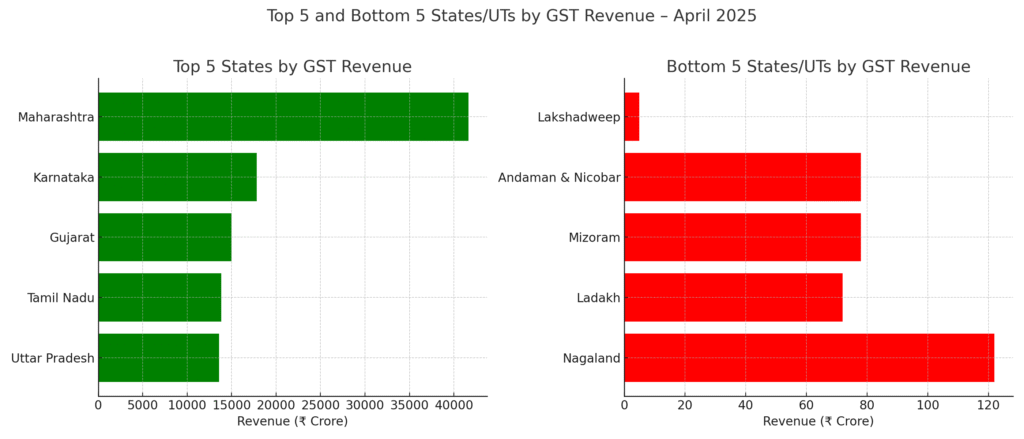
Among major states, Haryana posted the strongest monthly growth at +8%, followed by Karnataka (+11% on domestic pre-settlement SGST) and Kerala (+19% pre-settlement). Maharashtra remained the largest contributor, collecting ₹29,141 crore in May 2026. Delhi recorded a notable decline of 17%, while Tamil Nadu fell 15% year-on-year.
The total number of registered GSTINs rose to 94.9 lakh as of May 31, 2026, up from 70.3 lakh a year earlier, reflecting continued formalisation of the economy.
Formalisation of the Economy Continues
A particularly encouraging development was the continued growth in GST registrations.
The total number of registered GSTINs increased to 94.9 lakh as of May 31, 2026, compared with 70.3 lakh a year earlier.
The sharp rise in registrations indicates that more businesses are entering the formal economy and becoming part of the tax system. Over time, this broader taxpayer base can support stronger and more sustainable revenue growth.
Overall Assessment
India’s GST collections remained resilient in May 2026, with gross revenues reaching ₹1.94 lakh crore. Strong import growth and continued formalisation of the economy provided support to overall collections, while adjusted growth figures suggest underlying tax buoyancy remains healthy.
Future GST releases will help determine whether domestic demand regains momentum and whether the strong import-driven growth trend continues through the rest of FY2026-27.
All figures are provisional as of May 31, 2026, and may vary marginally upon finalisation.