The Union Cabinet, led by Prime Minister Narendra Modi, has approved the Emergency Credit Line Guarantee Scheme (ECLGS) 5.0 to support businesses affected by the ongoing West Asia conflict. The scheme aims to provide an additional credit flow of ₹2.55 lakh crore, mainly for MSMEs and the aviation sector.
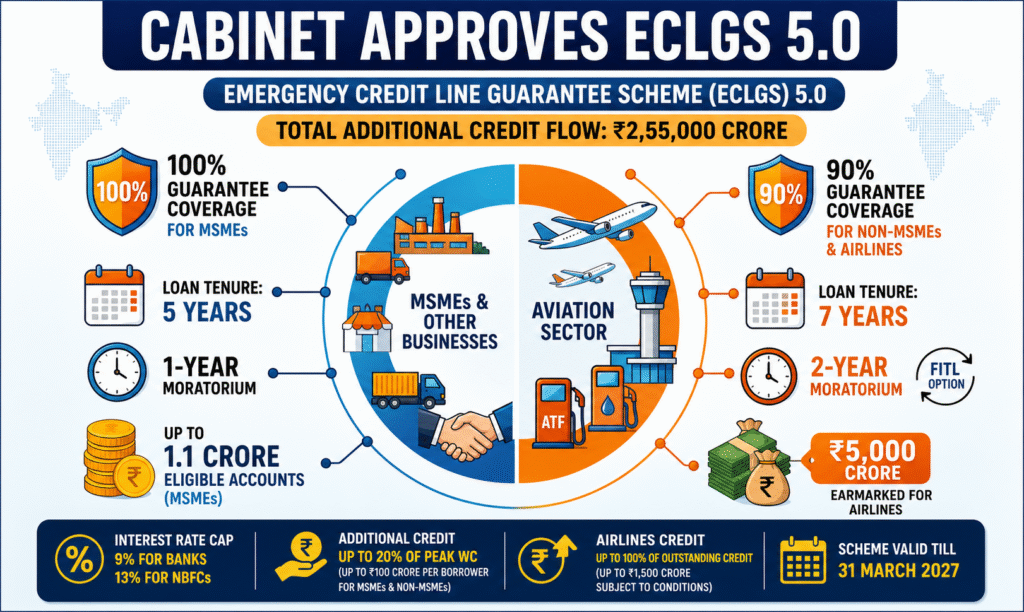
The scheme will be managed by the National Credit Guarantee Trustee Company Limited (NCGTC). Under ECLGS 5.0, MSMEs will receive 100% government guarantee coverage on eligible loans, while non-MSMEs and airlines will receive 90% guarantee coverage. The government has also reserved ₹5,000 crore specifically for airlines.
Background and Context
India’s economy is facing pressure because of the ongoing conflict in West Asia, which is an important supplier of crude oil to India. The rise in global oil prices has increased fuel costs, especially Aviation Turbine Fuel (ATF), creating financial stress for airlines.
At the same time, MSMEs are also facing problems such as supply chain disruptions, rising raw material costs, and pressure on working capital. This is not the first time the government has used the ECLGS framework to support businesses during a crisis. The scheme was first introduced during the COVID-19 pandemic. Earlier versions of ECLGS helped many businesses survive the economic slowdown. According to SBI Research, previous phases of the scheme prevented around 13.5 lakh MSME accounts from becoming non-performing assets (NPAs) and helped protect nearly 1.5 crore jobs.
ECLGS 5.0 has now been introduced to deal with the new economic challenges caused by global geopolitical tensions.
What is ECLGS 5.0?
ECLGS 5.0 is a government-backed credit guarantee scheme. Under this scheme, the National Credit Guarantee Trustee Company Limited (NCGTC) will provide guarantees to banks, NBFCs, and other financial institutions for additional loans given to eligible businesses.
The scheme is mainly designed to help businesses facing short-term liquidity problems because of the West Asia crisis. Loans under the scheme can be sanctioned from the date the guidelines are notified by NCGTC until 31 March 2027.
Key Features of the Scheme
Eligible Borrowers
The scheme is available for the following categories of borrowers whose accounts were classified as “standard” as of 31 March 2026:
- Micro, Small and Medium Enterprises (MSMEs) with existing working capital limits.
- Non-MSME businesses with existing working capital limits.
- Scheduled passenger airlines with outstanding credit facilities.
Guarantee Coverage
- MSMEs will receive 100% guarantee coverage under the scheme without paying any guarantee fee.
- Non-MSMEs will receive 90% guarantee coverage, also without any guarantee fee.
- The airline sector will also receive 90% guarantee coverage with no guarantee fee.
Quantum of Additional Credit
- MSMEs and non-MSMEs can receive additional credit of up to 20% of the peak working capital used during the fourth quarter of FY26, subject to a maximum limit of ₹100 crore per borrower.
- Airlines can receive additional credit equal to up to 100% of their outstanding credit, with a maximum limit of ₹1,500 crore under certain conditions.
Loan Tenure and Moratorium
- For MSMEs and non-MSMEs, the loan tenure will be five years from the date of first disbursement, including a one-year moratorium period.
- For airlines, the loan tenure will be seven years from the first disbursement, along with a two-year moratorium period.
Interest Rate Caps
- To keep loans affordable, the government has fixed interest rate limits under the scheme.
- Banks and financial institutions cannot charge more than 9% interest per year.
- NBFCs cannot charge more than 13% interest or benchmark-linked rates plus 0.75%, whichever is lower.
FITL Option
- Airlines will have the option to convert up to 50% of the interest accumulated during the moratorium period into a Funded Interest Term Loan (FITL).
- This will help airlines reduce immediate cash flow pressure and improve liquidity during the repayment holiday period.
Special Provisions for the Aviation Sector
The aviation industry has been one of the sectors most severely affected by the West Asia conflict. Airlines are facing several challenges, including rising ATF prices, airspace closures in conflict regions, reduced international flight operations, lower aircraft utilisation, and liquidity pressure.
To address these unique challenges, ECLGS 5.0 includes dedicated provisions for the aviation sector:
- ₹5,000 crore earmarked specifically for airlines out of the total ₹2,55,000 crore credit flow
- Maximum loan limit of ₹1,000 crore per airline borrower, with an additional ₹500 crore subject to equivalent equity infusion by the borrower
- An extended 7-year loan tenure with a 2-year moratorium, the longest among all borrower categories
- Option to convert up to 50% of the moratorium-period interest into a FITL
As of March 2026, the total outstanding bank credit to India’s aviation sector stood at around ₹52,600 crore. According to SBI Research, the ₹5,000 crore support package equals nearly 9.5% of the sector’s total outstanding bank credit, making it a significant support measure.
Impact on MSMEs
MSMEs are expected to be the biggest beneficiaries of ECLGS 5.0. India’s MSME sector plays an important role in employment, manufacturing, and exports, making its financial stability important for the overall economy.
According to SBI Research, nearly 1.1 crore MSME accounts could become eligible under the scheme. Around 45% of the total MSME loan portfolio in India may qualify for support.
Eligible MSME borrowers may receive an average additional credit of between ₹2 lakh and ₹2.3 lakh per account. By providing government-backed guarantees, the scheme is expected to increase lender confidence and ensure continuous credit flow to small businesses during a difficult global environment.
The government has stated that the scheme aims to prevent job losses, maintain production, and support supply chain stability.
Expected Economic Impact
The government expects ECLGS 5.0 to mobilise additional credit of ₹2.55 lakh crore across sectors. The estimated fiscal cost for the government is around ₹18,100 crore. The scheme may support up to 1.1 crore MSME accounts and provide ₹5,000 crore support specifically for airlines.
Like earlier ECLGS programmes, the scheme is also expected to help protect jobs across sectors. The scheme will remain valid until 31 March 2027.
The government also expects the scheme to reduce the impact of rising ATF and operational costs on airline passengers, helping maintain affordability in the aviation sector.
Government Statements
Union Civil Aviation Minister Shri Ram Mohan Naidu stated that ECLGS 5.0 will help airlines manage short-term liquidity challenges and maintain smooth operations during global disruptions.
He also said the scheme would provide strong financial support to protect jobs, maintain connectivity, strengthen the aviation ecosystem, and support MSMEs.