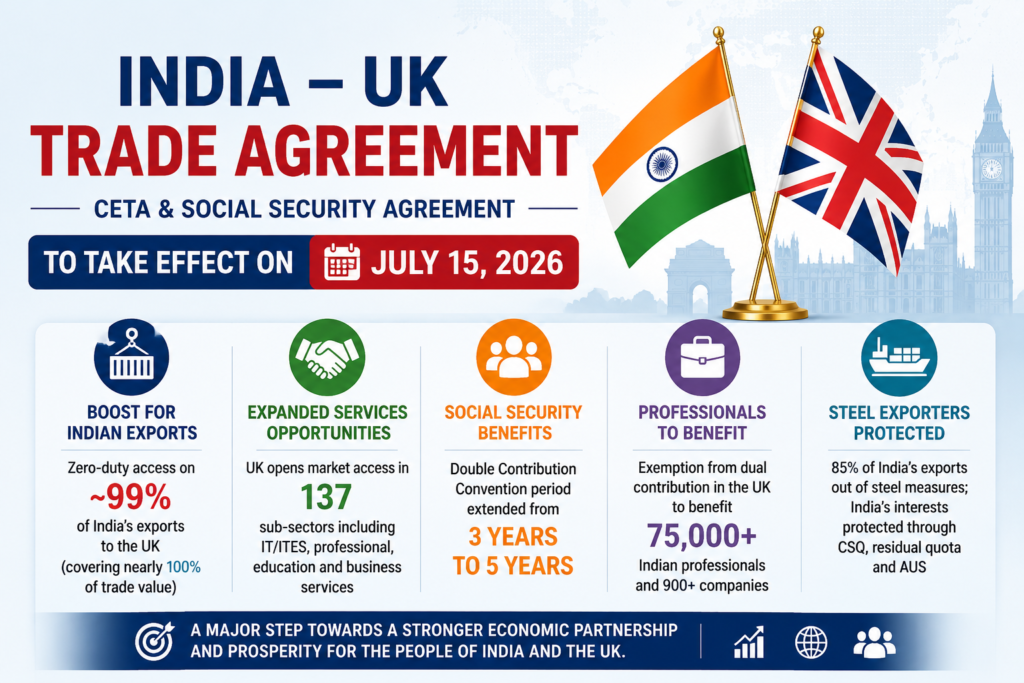
India and the United Kingdom have announced that the Comprehensive Economic and Trade Agreement (CETA) and the Agreement on Social Security Contributions, also known as the Double Contribution Convention (DCC), will come into force on July 15, 2026.
The implementation follows the completion of all required ratification procedures by both countries. The agreements are expected to deepen economic ties between India and the UK by improving market access for goods and services, supporting professional mobility, and reducing social security costs for Indian workers on temporary assignments in the UK.
Under CETA, around 99% of India’s exports to the UK by tariff lines will receive duty-free access, covering nearly 100% of the bilateral trade value. At the same time, the DCC extends the exemption period from dual social security contributions from three years to five years.
The agreements are part of the broader India-UK economic partnership framework established through the Enhanced Trade Partnership launched in 2021 and the India-UK Roadmap 2030, which aims to strengthen bilateral relations and increase trade between the two countries.
Key Highlights
- India-UK CETA and the Double Contribution Convention will take effect on July 15, 2026.
- Nearly 99% of India’s exports to the UK will receive duty-free access.
- The exemption period under the Double Contribution Convention has been extended from three years to five years.
- The UK has provided services market access commitments across 137 sub-sectors.
- More than 75,000 Indian professionals and over 900 companies are expected to benefit from the social security agreement.
- Indian chefs, yoga instructors, and classical musicians will receive dedicated annual mobility opportunities under the terms of the agreement.
India-UK Trade Agreement Becomes Operational
The foundation for the agreement was established in May 2021 through the Enhanced Trade Partnership and the India-UK Roadmap 2030. The two countries aimed to elevate their relationship to a Comprehensive Strategic Partnership and work toward doubling bilateral trade to USD 100 billion by 2030.
After fourteen rounds of negotiations, the Comprehensive Economic and Trade Agreement was concluded on May 6, 2025. The agreement was formally signed in London on July 24, 2025, by India’s Commerce and Industry Minister, Shri Piyush Goyal, and the UK’s Secretary of State for Business and Trade, Jonathan Reynolds, in the presence of Prime Minister Shri Narendra Modi and UK Prime Minister Sir Keir Starmer.
The accompanying Double Contribution Convention was signed on February 10, 2026, completing the overall economic cooperation framework.
CETA consists of 30 chapters covering trade in goods and services, digital trade, telecommunications, financial services, intellectual property, government procurement, innovation, sustainability, and support for small and medium enterprises.
Also Check: India-Oman CEPA Comes Into Force, Boosting Textile and Handicraft Exports
Duty-Free Access Expected to Boost Indian Exports
With the agreement entering into force, UK tariffs on several Indian products will be eliminated.
Products expected to benefit include processed food products, which currently face tariffs of up to 70%, marine products with tariffs of up to 21.5%, engineering goods and auto components facing tariffs of up to 18%, leather and footwear products with tariffs of up to 16%, textiles and clothing with tariffs of up to 12%, and chemicals and pharmaceutical products with tariffs of up to 8%.
The removal of tariffs is expected to improve the competitiveness of Indian exports in the UK market and create opportunities for farmers, fishermen, manufacturers, workers, and micro, small, and medium enterprises (MSMEs).
India has retained protection for several sensitive sectors, including dairy products, cereals, millets, edible oils, oilseeds, apples, and certain vegetable products.
Services Trade and Professional Mobility
The UK has provided market access commitments covering all major services sectors and 137 sub-sectors that are important for India.
The agreement covers sectors such as information technology and IT-enabled services, financial services, professional services, healthcare, education, engineering, telecommunications, and consulting services.
CETA also establishes mobility provisions for business visitors, intra-corporate transferees, contractual service suppliers, independent professionals, and investors.
In addition, the agreement creates dedicated annual mobility opportunities for 1,800 Indian chefs, yoga instructors, and classical musicians.
Social Security Agreement and Steel Trade Provisions
The Double Contribution Convention exempts Indian employees and employers from making social security contributions in both countries during temporary assignments in the UK. The exemption period has been increased from three years to five years.
According to the government, more than 75,000 Indian professionals and over 900 companies are expected to benefit from the arrangement. The agreement aims to reduce employment costs and support the cross-border movement of skilled professionals.
Separately, India and the UK have also reached an understanding regarding the UK’s steel trade measures scheduled to take effect on July 1, 2026.
According to the government, around 85% of India’s steel exports will remain outside the scope of these measures. For products covered by the measures, India will retain market access through a combination of country-specific quotas, residual quotas, and the Authorised Use Scheme (AUS).
Source: Ministry of Commerce & Industry